“As a peer researcher, I have been able to discover and better understand some of the realities in the teaching field in Nakivale Settlement, especially regarding refugee teachers’ inclusion, wellbeing, and agency.”
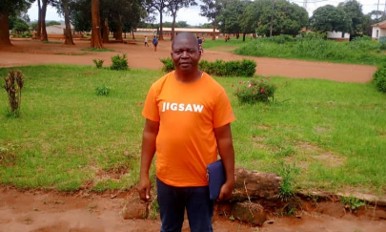
My name is Jean Bosco Nkengurutse. I am a Burundian refugee teacher and a Jigsaw peer researcher in Uganda. I fled Burundi and arrived in Uganda in July 2015. Fortunately, in August of the same year I got a teaching job as a teaching assistant and language instructor. This was mainly due to the large influx of refugees from French-speaking countries such as Burundi and the Democratic Republic of Congo.
Currently, I also work as a peer researcher in Uganda. This has been a very important opportunity for me because the experience I have gained is very valuable. As a peer researcher, I have been able to discover and better understand some of the realities in the teaching field in Nakivale Settlement, especially regarding refugee teachers’ inclusion, wellbeing, and agency.
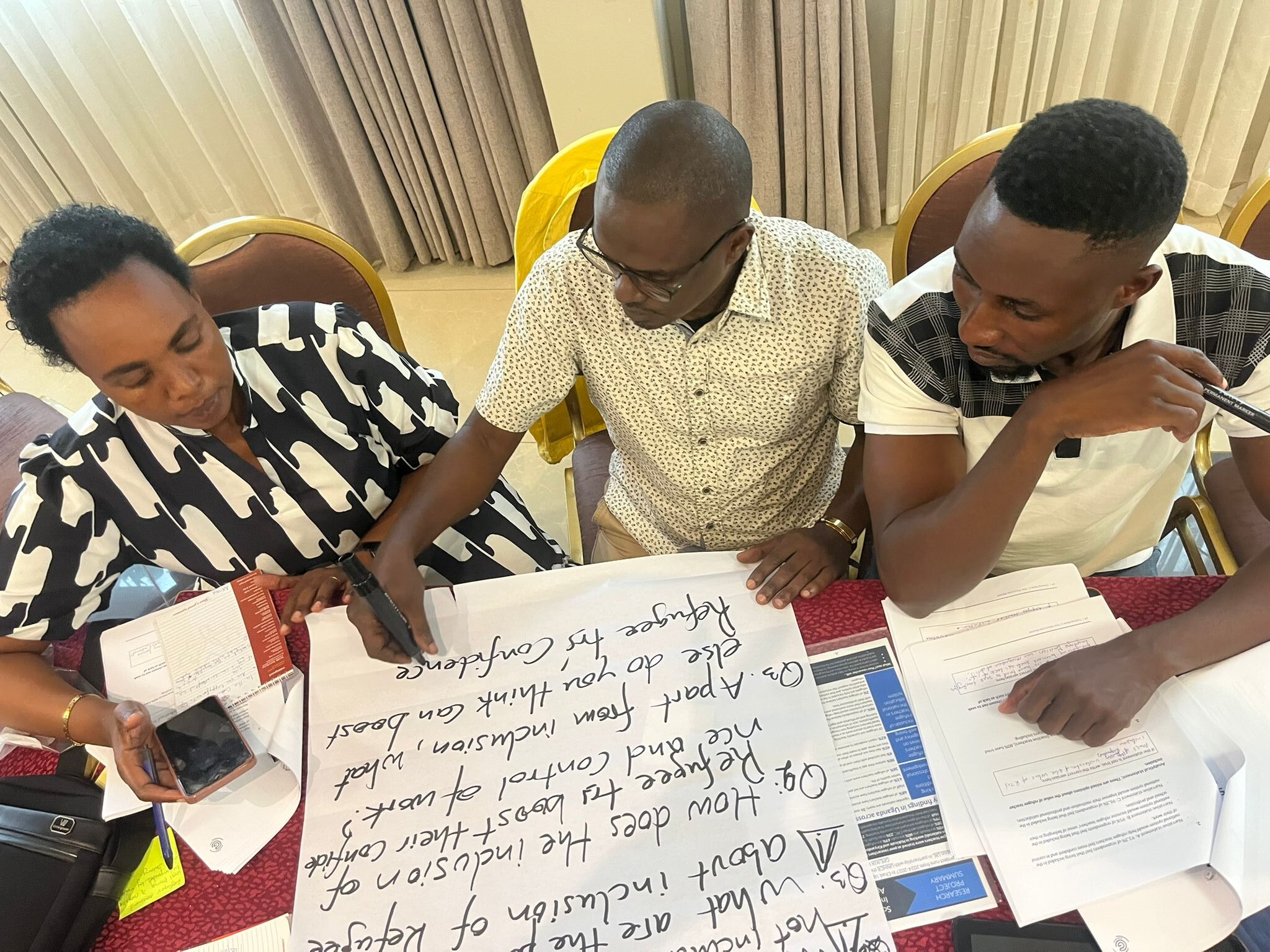
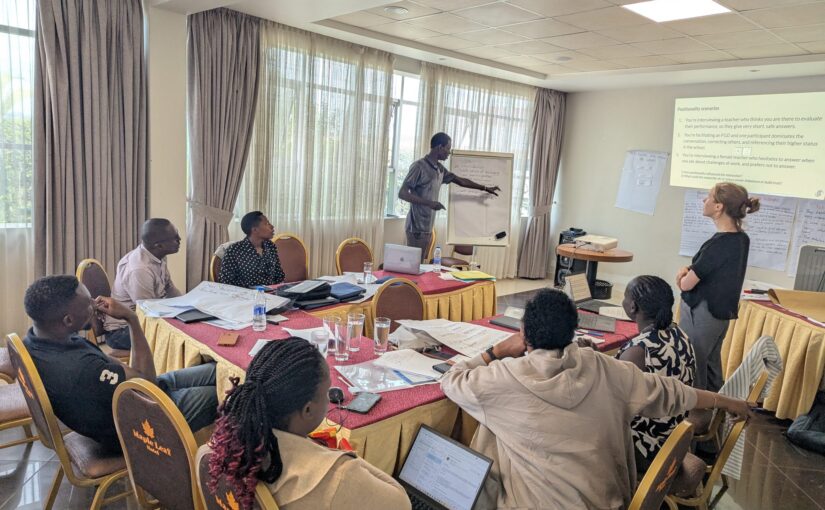
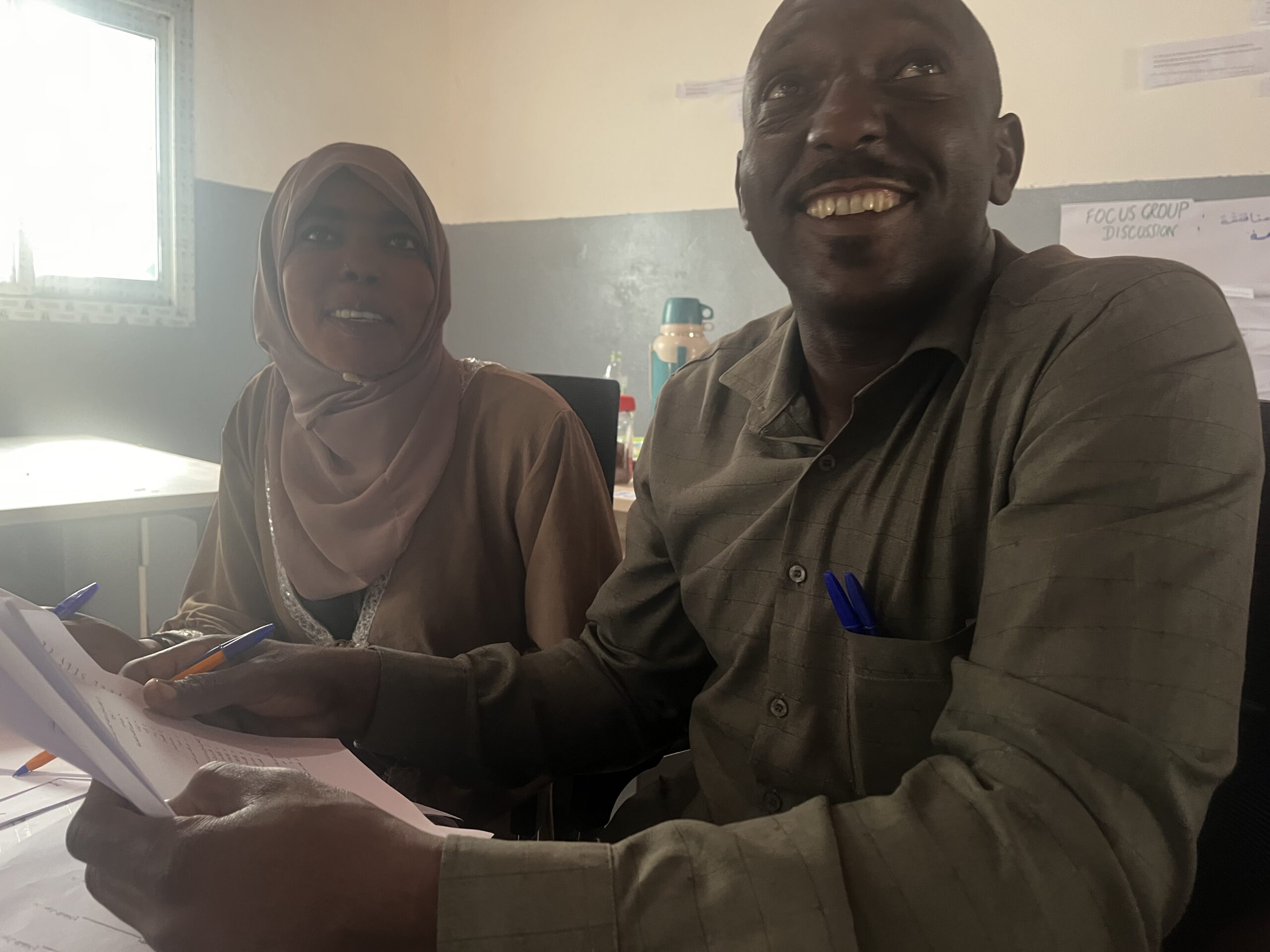
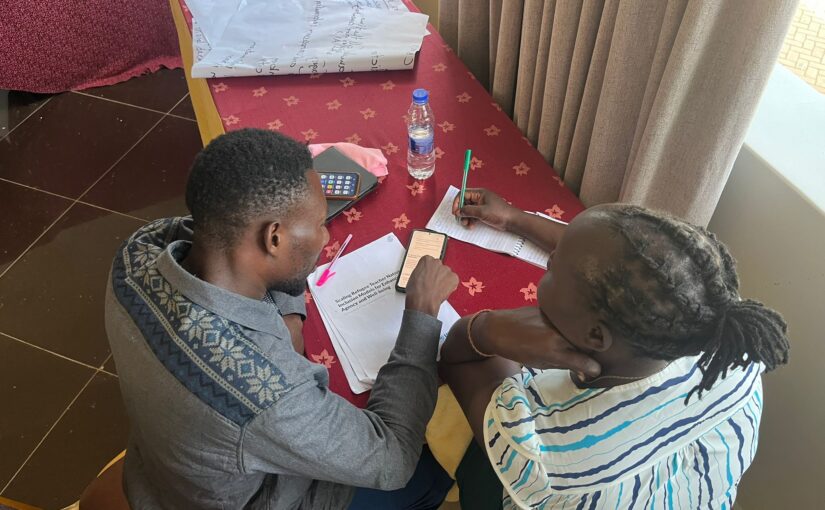
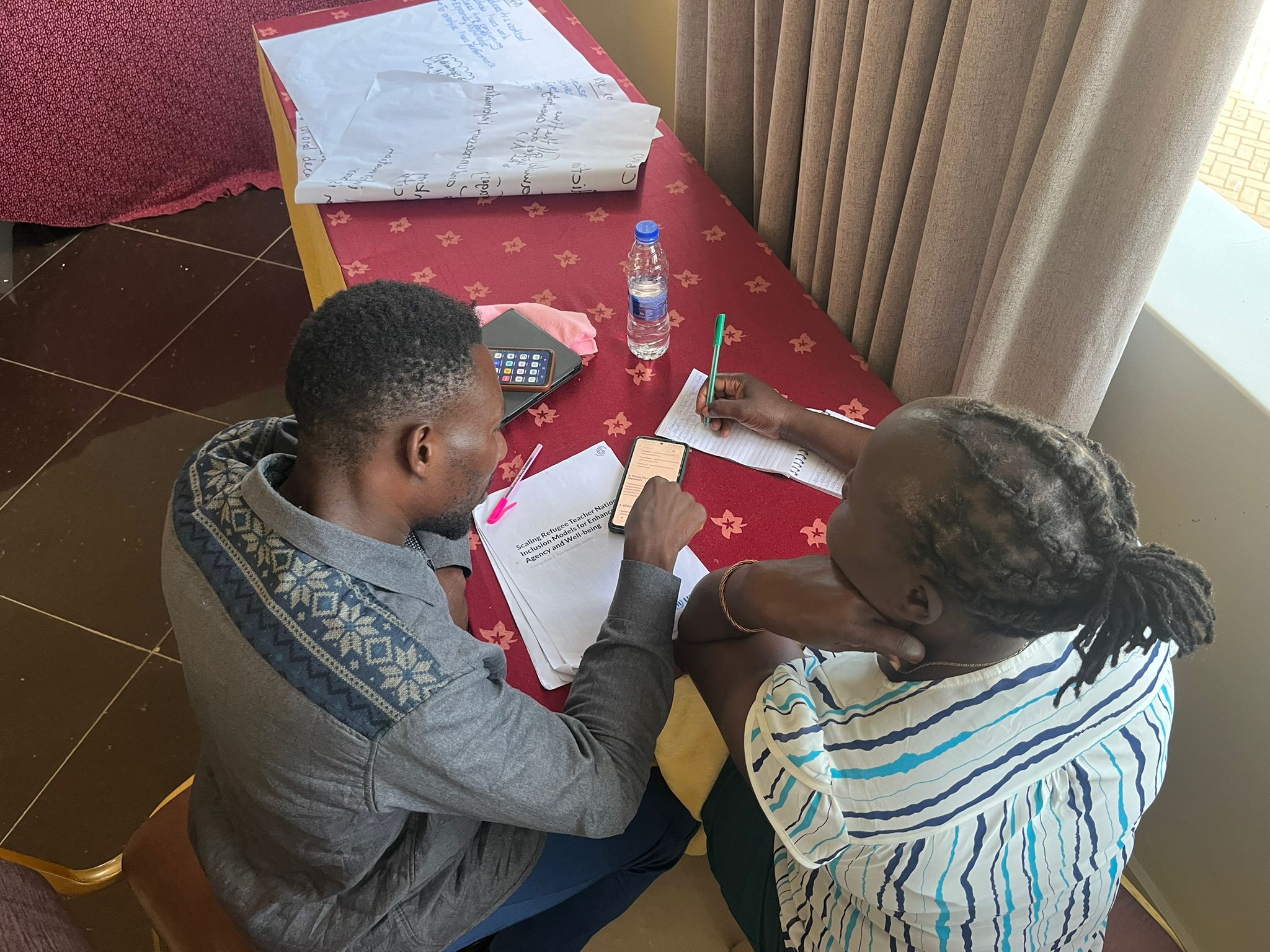
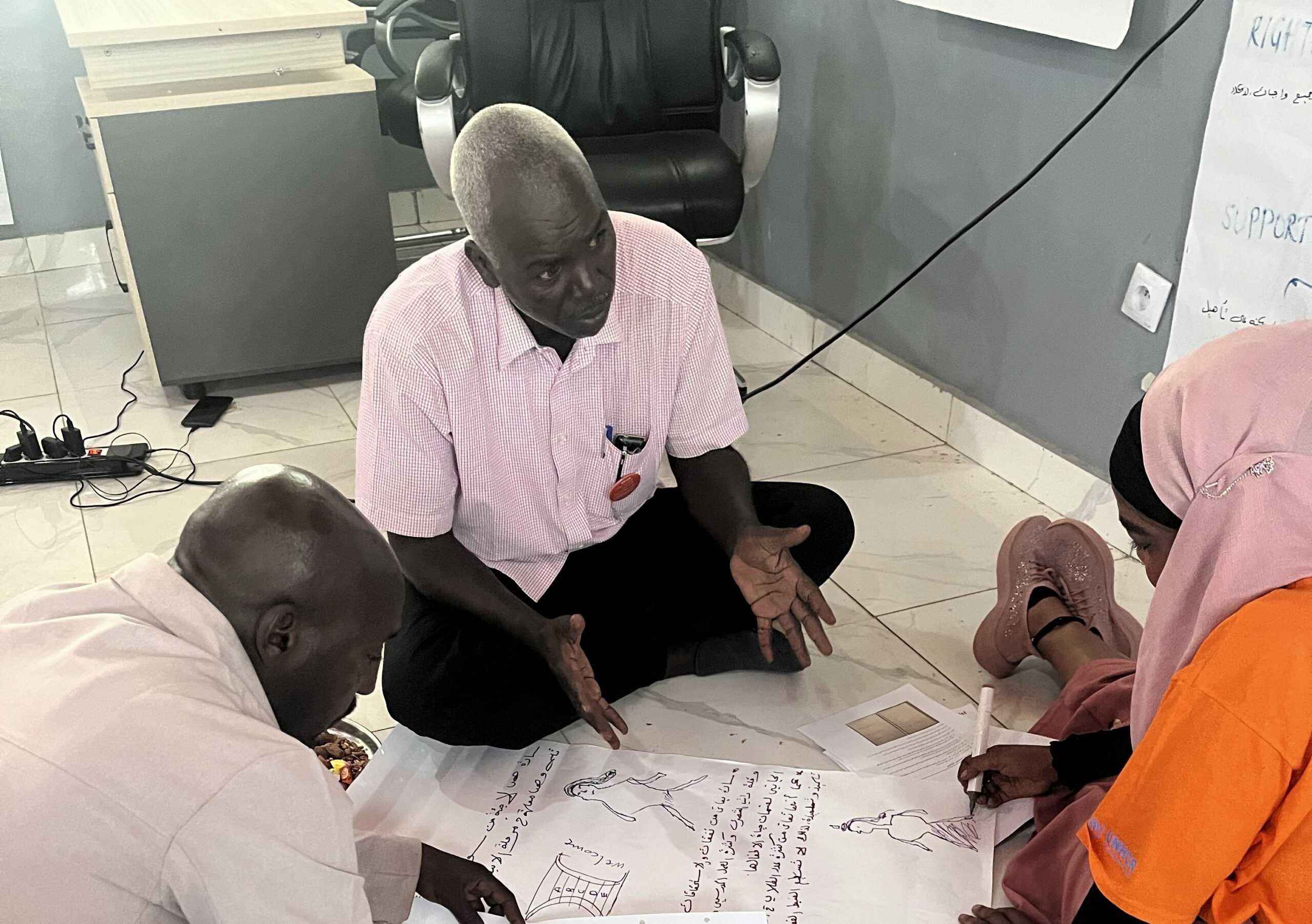
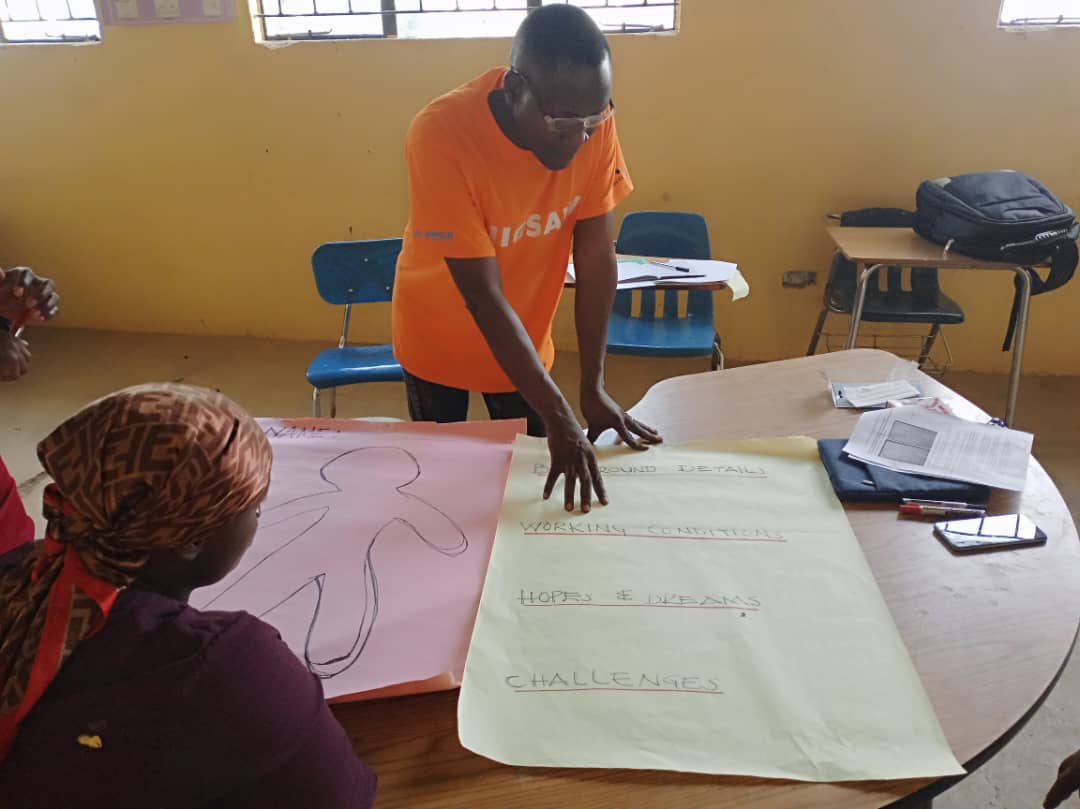
Jean Bosco collaborates with fellow peer researchers during a research training week.
I was also encouraged by the enthusiasm of the respondents. Many of them willingly came to participate in the research. They were interested in understanding the purpose of the research and how it could benefit them. This made the process very meaningful and enjoyable for me.
However, I also faced some challenges, which are common in this kind of activity. For example, some participants were absent at the last minute, some were not present in the settlement during the festive season, and sometimes the distances were very long.
Some questions were easier for respondents to answer, especially those related to refugee teachers’ wellbeing. These questions are very important and emotional because they touch on the general life conditions of refugee teachers. Other questions, particularly those related to agency, were more difficult for some respondents to answer.
Finally, I learned that this type of research should continue to be conducted regularly. It is important for understanding whether there is progress in the education sector for refugee teachers in different settlements.
This Think Piece is part of a series, featuring 18 refugee teachers from Chad, Uganda and Zambia. You can read the full publication here.
The contributors are peer researchers on a GERE study exploring refugee teacher inclusion, agency, and wellbeing. Read more about the study here.
“At first, the work felt challenging because I was not used to interviewing people in a formal way. However, it was also exciting because I was able to listen to teachers’ real experiences and learn from them.”
My name is Ajak William Bul Bior. I am a primary school teacher in Kiryandongo Refugee Settlement in Uganda. I have been teaching for three years. In my school, classrooms are often crowded and learning materials are limited. Even with these challenges, teaching is important to me because it gives children hope and knowledge for their future.
Recently, I had the opportunity to take part in a research project called “Scaling Refugee Teacher National Inclusion Models for Enhanced Wellbeing and Agency,” led by Jigsaw in partnership with Refugee Education UK and UNHCR. In this project, I helped to collect interview data from teachers. This gave me a new role, not only as a teacher but also as a peer researcher.
At first, the work felt challenging because I was not used to interviewing people in a formal way. However, it was also exciting because I was able to listen to teachers’ real experiences and learn from them. During the interviews, I spoke with both refugee teachers and national teachers. One moment I remember clearly was when a refugee teacher explained how difficult it is to have teaching certificates recognised in Uganda. Even though he had teaching experience in his home country, he could not easily get opportunities in Ugandan schools. This showed me that many refugee teachers have strong skills but face challenges they cannot control.
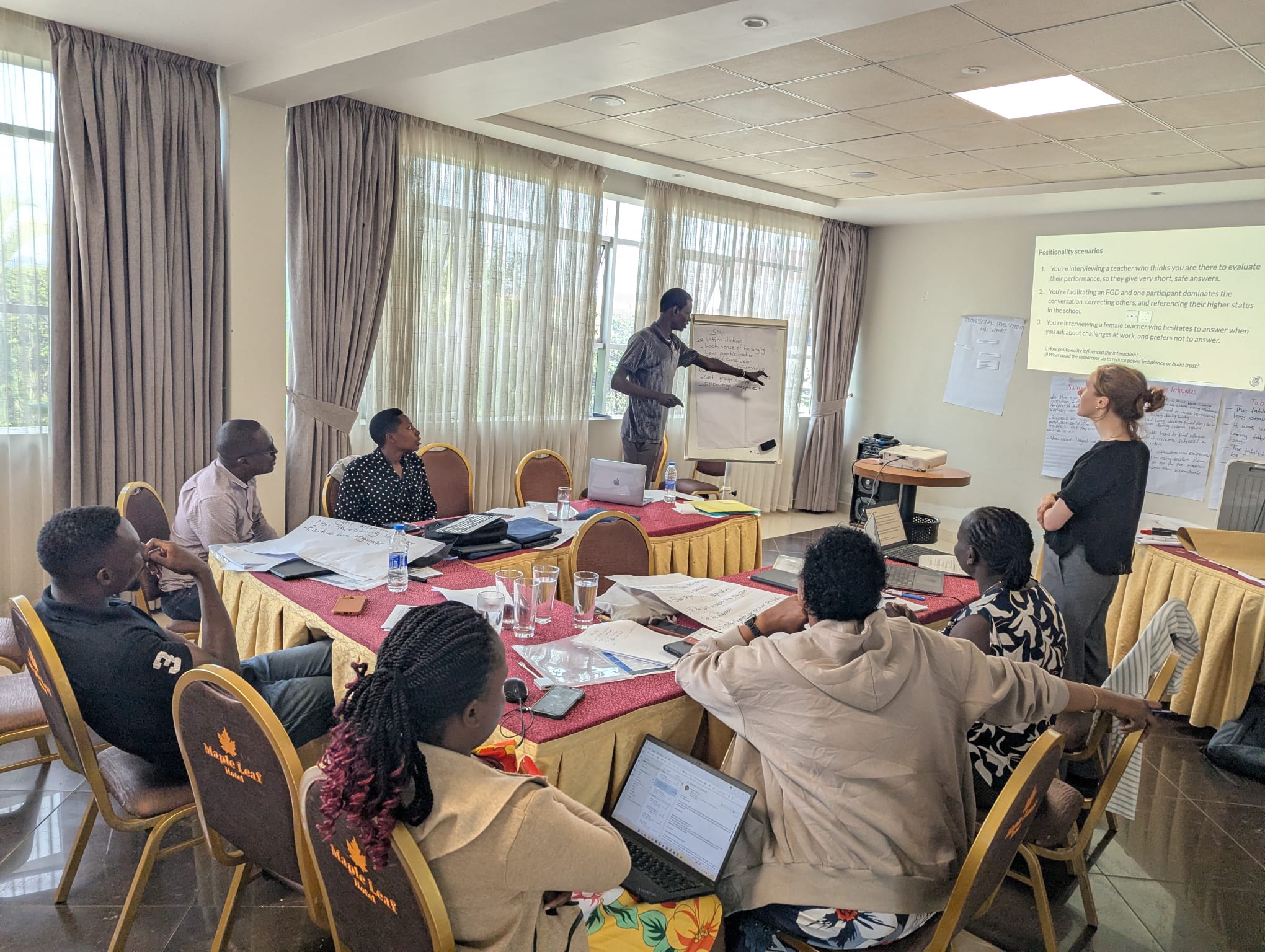
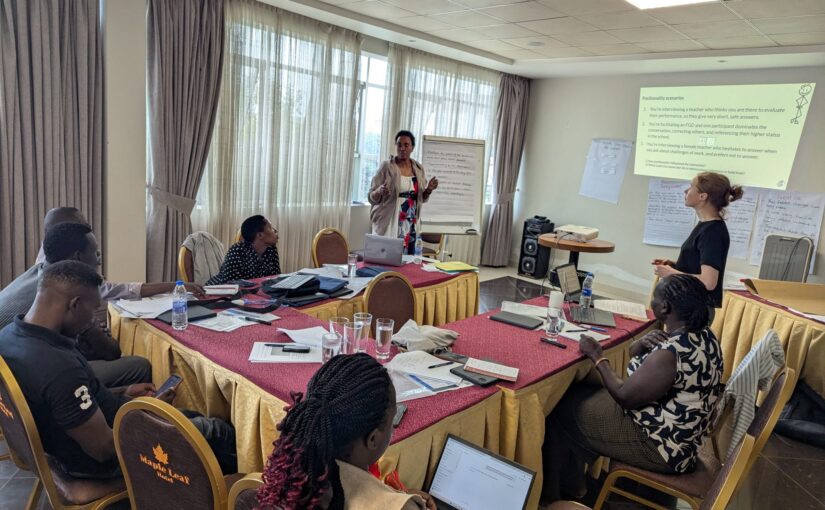
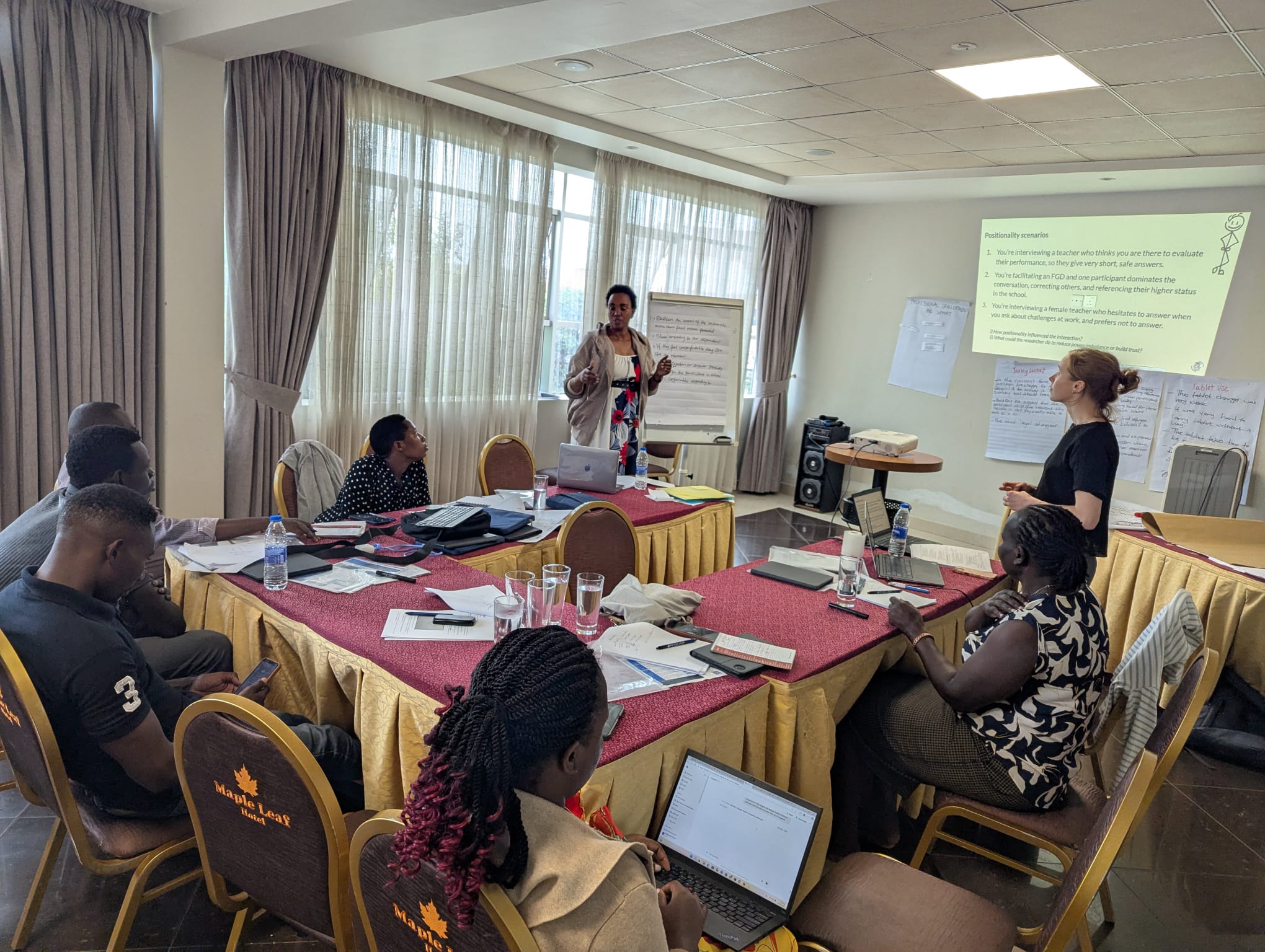
William presents to his fellow peer researchers and Jigsaw colleagues during a research training week.
I also noticed differences in how people shared their experiences. Refugee teachers often spoke openly about problems such as short contracts, low pay, and overcrowded classrooms. Some national teachers were supportive and believed refugee teachers should have equal opportunities, but sometimes they did not fully understand the difficulties refugees face.
One challenge during the research was asking questions about stress and discrimination. These topics were sensitive, and some participants became emotional. Because of this, I had to listen carefully and speak respectfully.
Overall, this experience helped me understand more about the real situations that refugee teachers face in their work. It also showed me how important it is to listen to teachers and learn from their experiences. Being a peer researcher helped me grow in confidence and responsibility, and it allowed me to see education in a different way.
I hope the findings from this research will help improve programming and support for refugee teachers so that their skills and experience can be recognised. When refugee teachers are supported and included, they can contribute more to education and help create better opportunities for learners in refugee communities.
This Think Piece is part of a series, featuring 18 refugee teachers from Chad, Uganda and Zambia. You can read the full publication here.
The contributors are peer researchers on a GERE study exploring refugee teacher inclusion, agency, and wellbeing. Read more about the study here.
“Carrying difficult memories, including the loss of loved ones and stability, changes you deeply. However, despite these challenges, teaching children has transformed my life and given me renewed purpose and hope.”
My full name is Hussein Ismail Hamid Serag. I am a Sudanese refugee based in Iridimi Camp, Chad, originally from El Fasher, Sudan. I have been living in Chad since 2023 following the outbreak of the ongoing war in Sudan.
I am a graduate of Sudan University of Science and Technology, Faculty of Languages and Translation (French-English). I began my teaching career in Sudan in 2021. Since then, I have taught both French and English in schools in my home country. After arriving in Chad, I was recruited as a primary school teacher in 2023. In 2024, I became the Director of the same school before being appointed as the Manager of the Digital Learning Center (DLC) in Iridimi Camp, Chad, in November 2025, a position I currently hold. At the DLC, I have also taught English and Basic Computer Skills to refugee learners.
I speak several languages, including Zaghawa (my local language), Arabic, English, French, Spanish, and Italian. My multilingual background has helped me communicate effectively with people from diverse backgrounds and has strengthened my ability to work in multicultural environments.
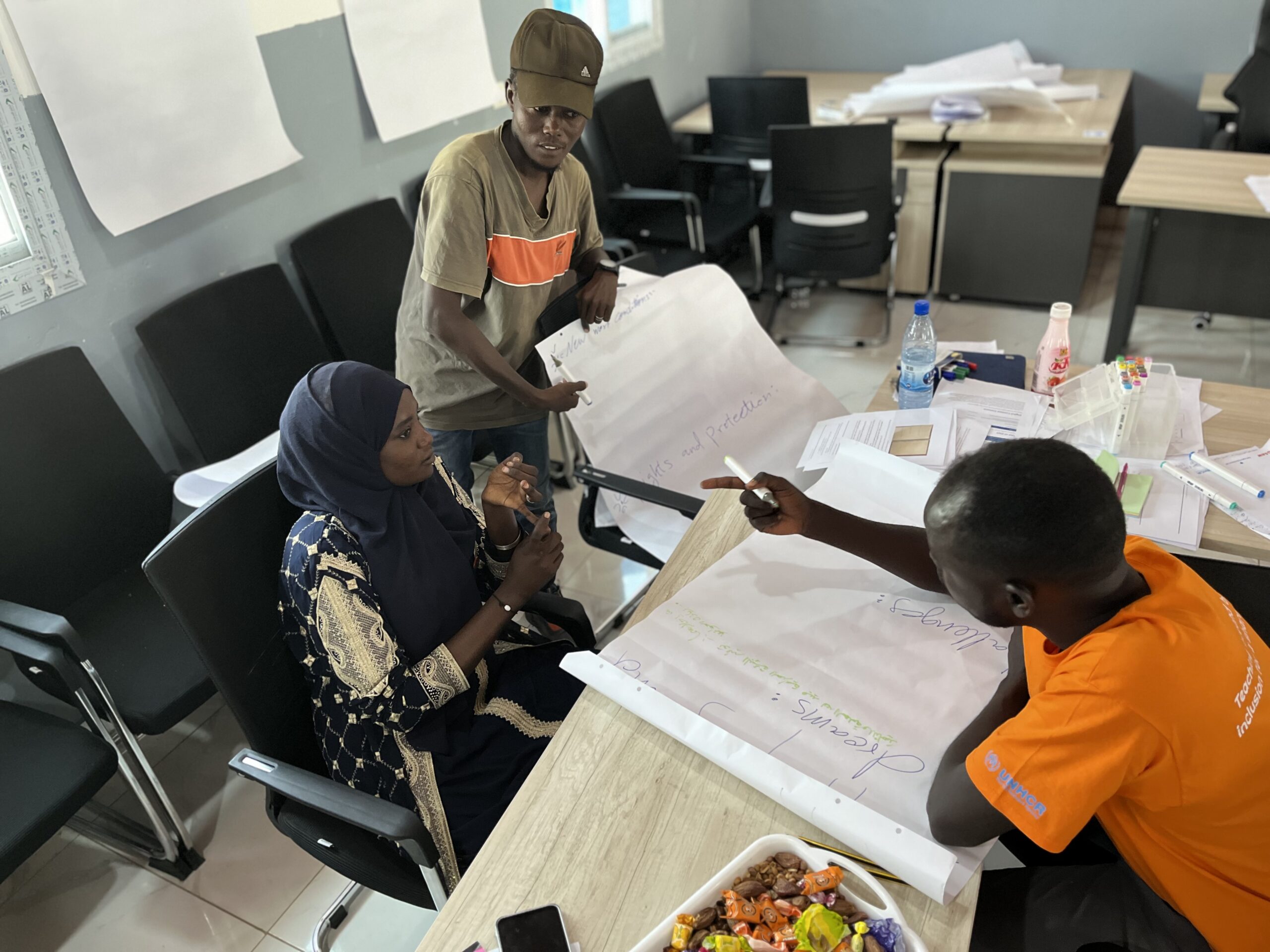
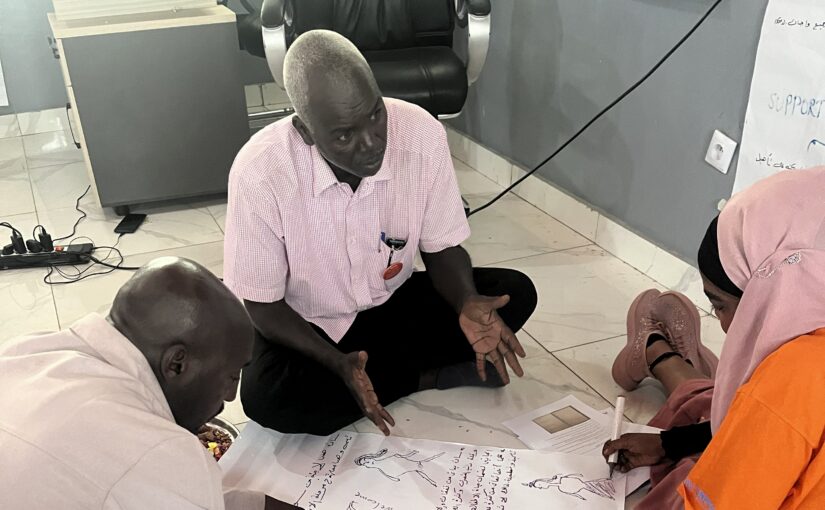
Hussein collaborates with fellow peer researchers during a research training week.
Working on this project has been a meaningful experience for me. It has allowed me to collaborate with dedicated educators, share ideas, and explore innovative teaching approaches. Through this journey, I have learned the importance of teamwork, communication, and adapting to challenges. The project has also strengthened my belief that education can create real change in communities when we work together with a clear vision.
One of the most rewarding aspects of my teaching experience is seeing students grow—not only academically, but personally. Watching them develop new skills, gain confidence, and overcome difficulties reminds me why I chose this profession.
I am grateful to be part of this initiative and excited to continue contributing to its goals. I look forward to learning more, sharing experiences, and supporting students in achieving their dreams.
It is never easy to abandon your hometown because of war. Leaving behind familiar streets, memories, relatives, and even job opportunities can be one of the most painful experiences in a person’s life. Carrying difficult memories, including the loss of loved ones and stability, changes you deeply. However, despite these challenges, teaching children has transformed my life and given me renewed purpose and hope.
This Think Piece is part of a series, featuring 18 refugee teachers from Chad, Uganda and Zambia. You can read the full publication here.
The contributors are peer researchers on a GERE study exploring refugee teacher inclusion, agency, and wellbeing. Read more about the study here.
“Refugee teachers have long been overlooked in terms of inclusion and policy recognition. Even those who are part of the system often work without clear conditions of service.”
My name is Isaac Zaji, a refugee teacher based in Meheba Refugee settlement in the North-western part of Zambia. I am a secondary school teacher.
I have been teaching for 26 years, and stepping into the role of a researcher during this study was both exciting and empowering. It felt like a dream come true; to finally have a platform to contribute to improving the welfare and inclusion of refugee teachers. I approached the research with confidence and a strong sense of purpose.
However, my own journey has not been without moments of discomfort and reflection. One particularly disturbing experience occurred during an audit, when questions were raised about how refugee teachers were employed within the national education system. Despite being legally employed through the Teaching Service Commission, the situation made me feel inadequate and highlighted a deeper issue: inclusion without full recognition.
Isaac during a data collection visit for the project.
Collecting data through interviews and Focus Group Discussions (FGDs) was insightful. While interviews often produced more structured responses, FGDs allowed participants to express themselves freely and in greater detail.
A deeply moving moment came when a retired refugee teacher revealed that he had not received his terminal benefits even after being laid off 13 years prior. Sadly, he passed away just a few months after sharing his story. Such moments underscored the urgency and importance of this research.
One particularly emotional moment during an FGD involved a retired teacher who had served diligently for 33 years. He shared how the Ministry of Education struggled to process his retirement due to issues with his residency permit. Eventually, he was retired with compensation equivalent to short-term contracts rather than full benefits. His story was both heart-breaking and powerful. It captured the reality faced by many refugee teachers.
If there is one message I would share, it is this: refugee teachers have long been overlooked in terms of inclusion and policy recognition. Even those who are part of the system often work without clear conditions of service. Advocacy has been limited but this is beginning to change. Initiatives like this research, supported by organisations such as Jigsaw Education and its partners, are a turning point.
This Think Piece is part of a series, featuring 18 refugee teachers from Chad, Uganda and Zambia. You can read the full publication here.
The contributors are peer researchers on a GERE study exploring refugee teacher inclusion, agency, and wellbeing. Read more about the study here.
“I’m motivated, enthusiastic, interested and cheerful about my job, although there are many challenges and obstacles that always discourage me.”
My name is Haidar Abakar Fedail. I have lived in Iridimi refugees settlement three since 2019 . I’m a secondary school biology teacher. In addition to that, I’m a university graduate, in medical laboratory science. I also run a medical laboratory after school.
I want to tell you about my experience at school. Let me tell you first about my feelings and motivations. I’m motivated, enthusiastic, interested and cheerful about my job, although there are many challenges and obstacles that always discourage me.
The working conditions are very hard and indescribable when compared with teaching in other countries. Right now in Iridimi [refugee settlement], teachers are on strike for four days following frequent, prolonged protests. Teachers were disappointed that their demands went unfulfilled. Our problems include lack of support, delayed and interrupted contracts, and insufficient salaries.
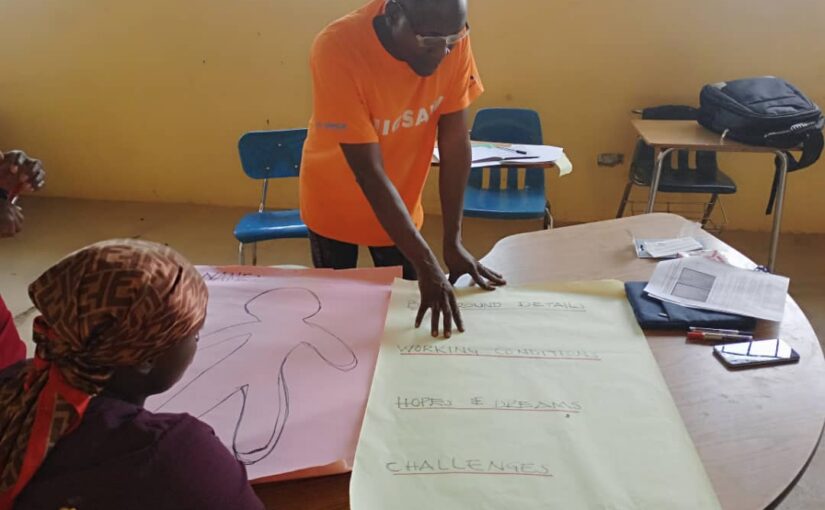
Haidar collaborates with a fellow peer researcher during a research training week.
We are having a terrible dispute and sharp discussions and negotiations with educational authorities in the location because they are not going to pay teachers for three months during their holiday . According to the latest information issued by UNHCR and JRS, refugee teachers in refugee settlements will not be paid during the coming summer holiday.
There’s also other challenges which affect teachers, such as lack of salary, wellbeing, inclusion and agency.
This Think Piece is part of a series, featuring 18 refugee teachers from Chad, Uganda and Zambia. You can read the full publication here.
The contributors are peer researchers on a GERE study exploring refugee teacher inclusion, agency, and wellbeing. Read more about the study here.
“[The] experience showed me how important it is to involve people who understand the community when conducting research. Using peer researchers helps build trust and allows participants to share their experiences more openly.”
My name is Margaret Atto. I am a refugee currently living in Uganda and a teacher by profession. I have taught for over 10 years. Currently I am volunteering, teaching both lower and advanced secondary level. I am also a peer researcher with Jigsaw and recently I had the opportunity to engage with and collect data from fellow refugee teachers about their experiences, challenges and opportunities in accessing teaching in the national education system.
As a refugee teacher and peer researcher, collecting data from fellow refugee teachers was both a practical and meaningful experience. Many participants felt comfortable sharing their stories with me because they knew that I was also a refugee and understood their situation. This created trust and openness during the discussions. Some participants confidently shared their personal journeys, the barriers they face in accessing teaching opportunities, and their efforts to continue contributing to education despite these challenges.
One important realisation during the research process was that refugee teachers often feel more comfortable discussing their experiences with fellow refugees who understand their context. Because of this shared background, they considered me more like a colleague than an outsider. This made it easier for them to openly share their experiences and provide rich and detailed information based on their practical teaching experiences. What I enjoyed most about collecting data was the opportunity to build trust with the refugee teachers. Through these conversations, I was able to collect meaningful and authentic information about how they cope with professional and social challenges. I also witnessed their strong passion for teaching and their determination to continue supporting learners, even in difficult circumstances.
Margaret collaborates with a fellow peer researcher during a research training week.
One particular thing that stood out for me was when a colleague shared how he offered to work as a translator in a primary school where most learners came from an Arabic – speaking background, while some of the national teachers didn’t understand the learners’ language. Because he understood the language, he helped translate the teacher’s explanations so that learners could better understand the concepts being taught. This showed how much refugee teachers can play an important role in bridging language cultural gaps in classrooms.
However, the data collection process also had its challenges. One of the main challenges was organising participants for Focus Group Discussions because the teachers lived in different villages within the settlement, which made it difficult to bring them together to attend the organised meeting. In some cases participants withdrew at the last minute due other commitments, making it difficult to get replacement or reschedule meetings. Despite these challenges, experience showed me how important it is to involve people who understand the community when conducting research. Using peer researchers helps build trust and allows participants to share their experiences more openly.
Above all, what stood out most was the resilience of refugee teachers. Despite facing many difficulties, including limited employment opportunities and lack of stable income, many of them continue teaching without pay because they believe in the importance of education and hope that their situation will improve in the future. One key lesson I learned from this experience is that the voices of refugee teachers need to be heard. Their challenges and contributions should be recognised and addressed with urgency. Research should not only focus on collecting information but also on understanding people’s experiences, building trust and using the findings to support meaningful change.
Participating in this research has enriched my experience in participatory research and strengthened my understanding of its role in promoting inclusion of refugee teachers in the national education system.
This Think Piece is part of a series, featuring 18 refugee teachers from Chad, Uganda and Zambia. You can read the full publication here.
The contributors are peer researchers on a GERE study exploring refugee teacher inclusion, agency, and wellbeing. Read more about the study here.
“Inclusive policies can strengthen education systems, promote social cohesion between refugees and host communities, and improve access to quality education for refugee learners.”
Education plays a vital role in shaping productive and responsible citizens. At the centre of every effective education system is a teacher, a trained professional who impacts knowledge, skill, values and attitudes to learners. Teachers help young people develop the capacity to contribute positively to their communities and the nation at large. To perform this role effectively, teachers require both intrinsic motivation, such as passion for teaching, and extrinsic motivation, including fair salaries, professional recognition and career advancement opportunities.
However, for many refugees and former refugee teachers in Zambia, particularly those living in Meheba refugee resettlement in Kalumbila District of Northwestern Zambia, participation in the national education system remains challenging. Despite their qualifications and dedication, many face structural barriers that limit their professional growth and inclusion.
Refugees are often forced to leave their countries due to war, political instability or persecution. Yet many arrive in host countries with valuable skills, qualifications and professional experience. Among them are trained teachers who are eager to continue serving communities through education.
The Refugee Teachers can help address teacher shortages in underserved communities, support refugee learners facing language and cultural barriers, promote intercultural understanding in classrooms, and strengthen education systems with diverse perspectives.
When effectively integrated into the national system, Refugee Teachers can contribute significantly to human capital development and social cohesion with host communities.
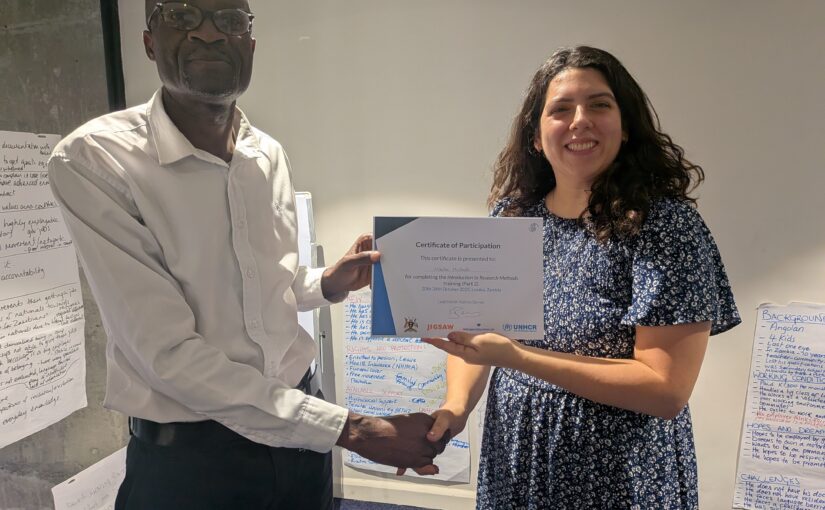
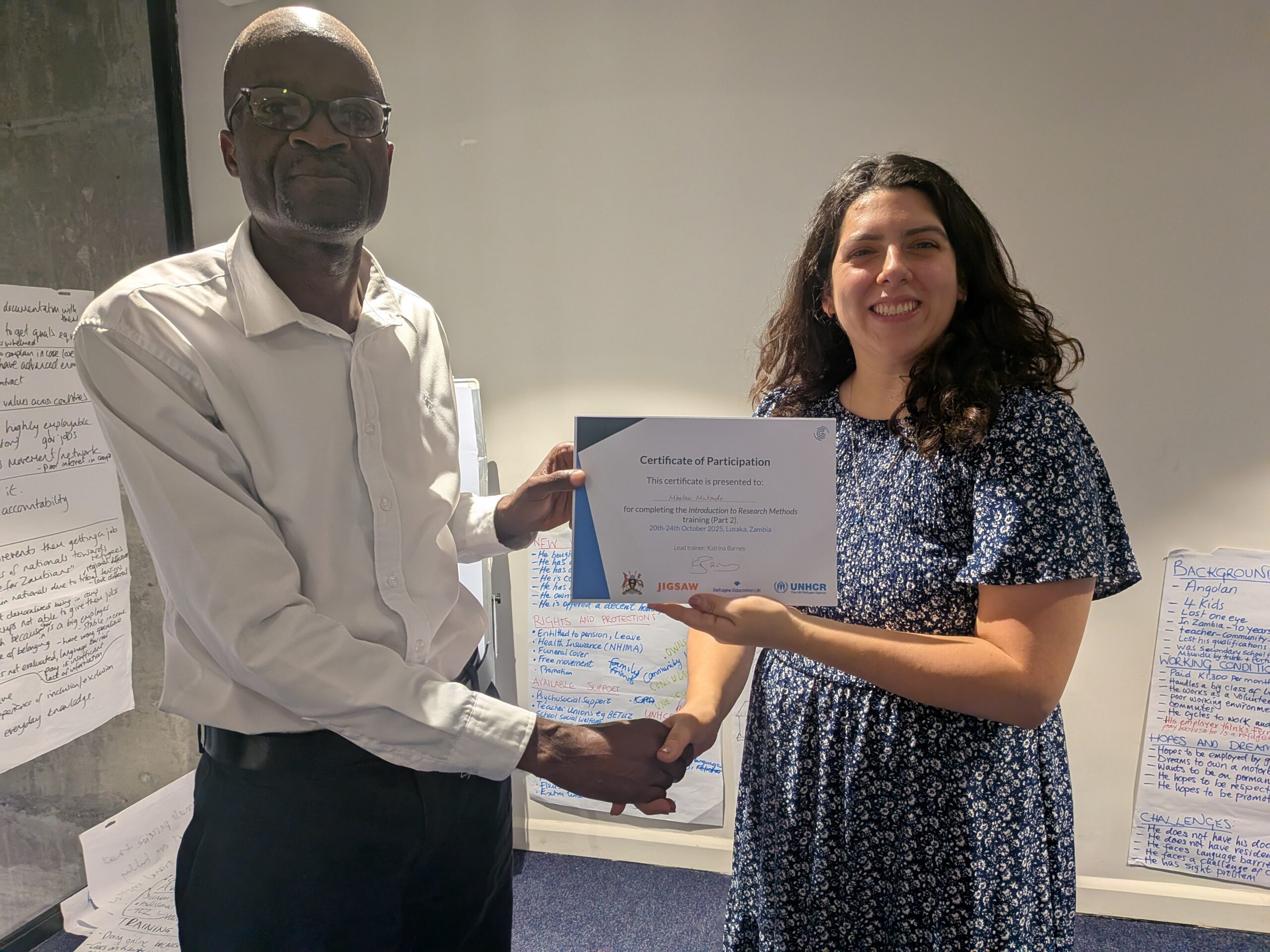
Mbalau receives a Certificate of Participation having completed his second research training week.
Our research conducted in Meheba, Mayukwayukwa and Lusaka, through interviews, questionnaires and Focus Group Discussion identified several barriers that limit the participation of refugee and former refugee teachers in Zambia’s national education system. These include employment discrimination related to refugee status, high cost of tertiary education, expensive teacher registration fees, and costly study permits required for further education.
Additional challenges include language barriers for teachers from French or Portuguese speaking countries, the complex process of recognising foreign academic qualifications, low salaries in private schools where many refugee teachers work, and restrictions of movement outside the refugee settlement that hinder job searching and professional development opportunities. In addition, refugee teachers continue to use the Alien National Registration Card while Zambian nationals use the National Registration Card that ends with stroke 1. This distinction sometimes reinforces a sense of exclusion within professional spaces.
My journey reflects many of the experiences shared by refugee teachers in Meheba Refugee Settlement.I began working as a young Refugee Teacher in September 2001. Before entering the profession, I completed my primary education and later attended Secondary School from 1991 to 1996.
When I joined the national education system, I received the same training and salary structure as Zambian teachers. However, challenges remained. Promotion opportunities have often been limited for refugee teachers despite years of service and experience.
Ensuring the inclusion of refugee and former refugee teachers in the national education system is not just a matter of fairness but also a strategic investment in education.Inclusive policies can strengthen education systems, promote social cohesion between refugees and host communities, and improve access to quality education for refugee learners. Recognising the contribution of refugee educators allows countries to utilise valuable human resources that can contribute to national development and educational advancement.
The experiences shared by refugee and former refugee teachers in Meheba Refugee Resettlement highlight important challenges within the broader education system. Although these educators possess the qualification, dedication and passion required to teach effectively, structural barriers continue to limit their opportunities for professional growth and full participation. For meaningful inclusion to occur, policymakers and education shareholders should review policies related to teacher recruitment, promotions, qualification recognition and career advancement for refugee educators. A more inclusive education system will empower refugee teachers while strengthening Zambia’s commitment to equitable and quality education for all.
This Think Piece is part of a series, featuring 18 refugee teachers from Chad, Uganda and Zambia. You can read the full publication here.
The contributors are peer researchers on a GERE study exploring refugee teacher inclusion, agency, and wellbeing. Read more about the study here.
“After I was given the role of peer researcher, I began communicating with peer researchers in different countries and exchanging ideas with them.”
I live in a refugee settlement in Chad and work as a teacher in refugee community schools. I worked as a teacher from 2005 to 2009 in Sudan. And from 2009 until now, I have been working in refugee community schools in Chad. It seems to me that working as a teacher in the context of refugee environments requires endurance and patience because in emergency situations, there is no clear plan for implementation, the learning environment is poor, and there is a lack of educational resources and infrastructure.
My experience in data collection – both as a teacher and a peer researcher – fills me with pride and a sense of accomplishment. This has been my life’s work. I can compare teaching in my home country to teaching in a refugee setting, and there is a significant difference.
Mahamat collaborates with fellow peer researchers during a research training week.
I have been waiting for such an opportunity to conduct research for a while, and we hope to complete the research according to the plan. The research has changed my perspective for the better. I used to be a teacher in my homeland, and now, as a refugee, I had been cut off from communicating with others and conducting research. But after I was given the role of peer researcher, I began communicating with peer researchers in different countries and exchanging ideas with them.
The interviews and Focus Group Discussions I conducted with the participants, did not always go as expected or as planned. The people, the timings, and the places changed. In fact, when I conducted the interviews and discussions, no one I had scheduled to meet with refused to participate, but some cited exceptional circumstances, so they were replaced by other participants. The questions were answered well, but there were a few that were difficult to answer because the question was weak or the participant lacked information. Also, the environment had an impact on the interviews and discussions, particularly in institutions such as schools. There was noise that disrupted the recording process. As for the logistical aspect, I borrowed some equipment such as chairs and tables from the schools. The reaction from the participants was good. There were no national teachers among the participants, so we were unable to observe any differences.
The primary method I used for data collection was interviews. Participants often provided useful background information on education during the interviews. From the interviews and group discussions, I gathered that participants felt the inclusion process—even if it were to take place—would be difficult to implement, which surprised me.
I did not face any significant challenges throughout my work period because I made plans in an agreement with the participants regarding timing and location. There are no national teachers on the list and so there is no language barrier. However, some questions were awkwardly phrased – when I asked a question and asked them to answer, they would sometimes repeat the question back to me.
I benefited from this experience by sharing my insights and experiences through this blog with readers interested in the education of refugee children. I also learned a great deal about research, including types of research, data collection methods, and research frameworks. On the teaching front, I’ve sought to understand the educational issues and challenges faced by refugee communities amid the suspension of aid from donors and funders; the lack of such aid negatively impacts both individuals and society as a whole. I am sharing this piece with readers to reflect the life I live, and through this blog, I will continue to share my experiences with others.
This Think Piece is part of a series, featuring 18 refugee teachers from Chad, Uganda and Zambia. You can read the full publication here.
The contributors are peer researchers on a GERE study exploring refugee teacher inclusion, agency, and wellbeing. Read more about the study here.
“This research opened my eyes and transformed me—I am not the same person who started this journey.”
My name is Nduwimana Anitha. I am a 41-year-old refugee from Burundi, a mother of four, and currently living in Nakivale Refugee Settlement in Uganda, where I have spent the last ten years. I hold a Bachelor’s degree in Educational Sciences with a concentration in English (Licence en Sciences de l’Éducation, Département d’Anglais). After six years of unemployment, I began volunteering as a French teacher in a private secondary school within the settlement.
At the beginning, the journey was not easy. I often felt confused, speechless, and sometimes isolated. However, standing in front of my students slowly reminded me of a dream I had carried for many years: to serve others and contribute to education in a humanitarian context. Teaching young people in the settlement helped me rediscover my purpose.
Anitha presents to her fellow peer researchers and colleagues during a research training week.
Through this project, I had the opportunity to conduct interviews and Focus Group Discussions with refugee teachers, national teachers, school directors, and other education authorities. Listening to their experiences opened my eyes. I realised that many refugee teachers are not aware of the pathways to access employment or the laws that affect their professional opportunities. I was also surprised to hear some teachers say that after many years of unemployment or very low salaries, they had started to accept their difficult situation as their destiny.
Being involved in this research was a transformative experience. It allowed me to interact with school leaders and strengthened my skills in research and teaching methodology. It also encouraged me to be more creative and innovative in my classroom.
Most importantly, this journey changed me. It gave me confidence not only in my professional life but also in my role as a woman and a mother. Today, I feel empowered and proud of the work I am doing with my learners. This research opened my eyes and transformed me—I am not the same person who started this journey.
This Think Piece is part of a series, featuring 18 refugee teachers from Chad, Uganda and Zambia. You can read the full publication here.
The contributors are peer researchers on a GERE study exploring refugee teacher inclusion, agency, and wellbeing. Read more about the study here.
My name is Vasco Musebo, a peer researcher for Jigsaw in Zambia. I am a Congolese refugee, and have lived in Meheba refugee settlement since 2016.
I am a non-active refugee teacher. I worked as a language teacher for seven years, five in my country of origin (the DRC), and two here in Zambia.
In fact, being a refugee and a researcher at the same time (collecting interview and Focus Group Discussion data with both national and refugee teachers) seemed quite difficult at the beginning. I assumed that it could be seen to be playing with fire as many organisations and individuals across the world were to hear the outcome of my findings, including the Zambian government.
It felt to me as if we were challenging the government by examining and exposing their weakness in the education sector, which seemed somehow offensive in nature. Fortunately, the more I engaged myself in the assignment, the more fearless I became. I discovered that I was not alone, but surrounded by a very powerful shell of defense composed of a variety of well-placed organisations and stakeholders.
Furthermore, visiting and meeting other nationalities and collecting data from them was unbelievable. Every ethnic group has a way of sharing their hidden secrets, information or thoughts with others and, sometimes, they cannot open up regardless of your position or authorisation.
Vasco prepares resources ahead of data collection.
What made me successful in the data collection was the experience I already had as a teacher of different nationalities, as well as the knowledge, strategies, and code of conduct I acquired through the training from Jigsaw.
Regarding the Focus Group Discussion, I experienced something very admirable (to be highlighted in this narrative of course). At first, the interaction with our participants was balanced from both parts (between national teachers and refugee teachers). But later on, I was amazed and unexpectedly surprised to see and hear the national teachers expressing their bitterness on behalf of refugee teachers, who are treated with less consideration of their rights and working conditions (poor payment, refugee teacher inclusion almost not there, etc…).
I remember one of the national teachers declaring, “We are all one, all Africans, same blood color, created by one God; everyone can be a refugee, but why is it that a refugee teacher is segregated?”. It was so touching to hear.
From this experience, I deeply understood that this research is a very significant opportunity and has paved the way for participants to open their hearts and share their hidden demands for change in the intellectual world.
I would simply encourage Jigsaw and all the parties involved into this research, not to give up until participants’ request is granted. I pledge to remain supportive, engaged into this struggle until the dream is fully achieved.
“Together as one”, “Together we can.”
This Think Piece is part of a series, featuring 18 refugee teachers from Chad, Uganda and Zambia. You can read the full publication here.
The contributors are peer researchers on a GERE study exploring refugee teacher inclusion, agency, and wellbeing. Read more about the study here.