Why inclusion matters for refugee teachers
“Inclusive policies can strengthen education systems, promote social cohesion between refugees and host communities, and improve access to quality education for refugee learners.”
Education plays a vital role in shaping productive and responsible citizens. At the centre of every effective education system is a teacher, a trained professional who impacts knowledge, skill, values and attitudes to learners. Teachers help young people develop the capacity to contribute positively to their communities and the nation at large. To perform this role effectively, teachers require both intrinsic motivation, such as passion for teaching, and extrinsic motivation, including fair salaries, professional recognition and career advancement opportunities.
However, for many refugees and former refugee teachers in Zambia, particularly those living in Meheba refugee resettlement in Kalumbila District of Northwestern Zambia, participation in the national education system remains challenging. Despite their qualifications and dedication, many face structural barriers that limit their professional growth and inclusion.
Refugees are often forced to leave their countries due to war, political instability or persecution. Yet many arrive in host countries with valuable skills, qualifications and professional experience. Among them are trained teachers who are eager to continue serving communities through education.
The Refugee Teachers can help address teacher shortages in underserved communities, support refugee learners facing language and cultural barriers, promote intercultural understanding in classrooms, and strengthen education systems with diverse perspectives.
When effectively integrated into the national system, Refugee Teachers can contribute significantly to human capital development and social cohesion with host communities.
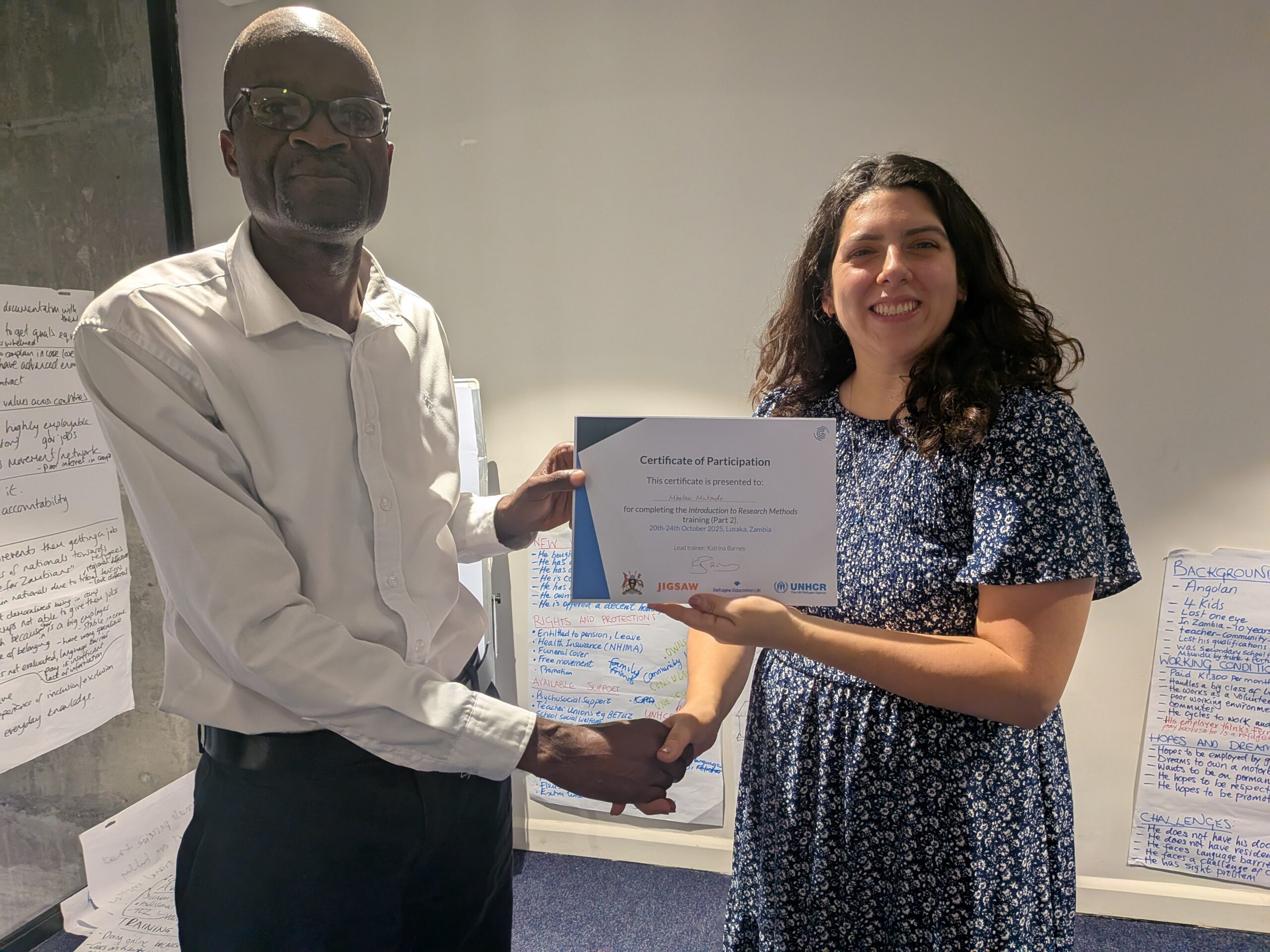
Our research conducted in Meheba, Mayukwayukwa and Lusaka, through interviews, questionnaires and Focus Group Discussion identified several barriers that limit the participation of refugee and former refugee teachers in Zambia’s national education system. These include employment discrimination related to refugee status, high cost of tertiary education, expensive teacher registration fees, and costly study permits required for further education.
Additional challenges include language barriers for teachers from French or Portuguese speaking countries, the complex process of recognising foreign academic qualifications, low salaries in private schools where many refugee teachers work, and restrictions of movement outside the refugee settlement that hinder job searching and professional development opportunities. In addition, refugee teachers continue to use the Alien National Registration Card while Zambian nationals use the National Registration Card that ends with stroke 1. This distinction sometimes reinforces a sense of exclusion within professional spaces.
My journey reflects many of the experiences shared by refugee teachers in Meheba Refugee Settlement.I began working as a young Refugee Teacher in September 2001. Before entering the profession, I completed my primary education and later attended Secondary School from 1991 to 1996.
When I joined the national education system, I received the same training and salary structure as Zambian teachers. However, challenges remained. Promotion opportunities have often been limited for refugee teachers despite years of service and experience.
Ensuring the inclusion of refugee and former refugee teachers in the national education system is not just a matter of fairness but also a strategic investment in education.Inclusive policies can strengthen education systems, promote social cohesion between refugees and host communities, and improve access to quality education for refugee learners. Recognising the contribution of refugee educators allows countries to utilise valuable human resources that can contribute to national development and educational advancement.
The experiences shared by refugee and former refugee teachers in Meheba Refugee Resettlement highlight important challenges within the broader education system. Although these educators possess the qualification, dedication and passion required to teach effectively, structural barriers continue to limit their opportunities for professional growth and full participation. For meaningful inclusion to occur, policymakers and education shareholders should review policies related to teacher recruitment, promotions, qualification recognition and career advancement for refugee educators. A more inclusive education system will empower refugee teachers while strengthening Zambia’s commitment to equitable and quality education for all.

This Think Piece is part of a series, featuring 18 refugee teachers from Chad, Uganda and Zambia. You can read the full publication here.
The contributors are peer researchers on a GERE study exploring refugee teacher inclusion, agency, and wellbeing. Read more about the study here.
Funding
This work is supported by the Global Partnership for Education Knowledge and Innovation Exchange, a joint endeavour with the International Development Research Centre, Canada. The views expressed herein do not necessarily represent those of IDRC or its Board of Governors.